








Cyprus Non-Dom Status, Cyprus Tax and Cyprus Residence
Cyprus is an EU member state with a warm Mediterranean climate all year. It has built one of the most welcoming tax systems in Europe for entrepreneurs, traders and investors who move between countries. This page explains how Cyprus Non-Dom Status works, the eight benefits it can bring, the 2026 personal income tax bands, the requirements and how to apply, and the three ways EU citizens can move here.
Table of Contents
- Move to Cyprus and Gain Real Tax Advantages
- Cyprus Non-Dom Status: Why It Matters
- Benefits of Cyprus Residence with Non-Dom Status
- Current Cyprus Personal Income Tax Rates
- Worked Example
- Requirements for Cyprus Non-Dom Status
- Applying for Cyprus Non-Dom Status
- Three Routes to Cyprus Residence with Non-Dom Status
- Moving Your Residence to Cyprus

Move to Cyprus and Gain Real Tax Advantages
Cyprus is a full member of the European Union and has been an independent country since 1960. Its Mediterranean way of life, more than 340 days of sunshine a year, and its plants and wildlife draw more than three million visitors each year. Cyprus is also seen as one of the safer countries in the world, including in political terms, and it scores well on international crime indexes.
This safety, a relaxed setting with friendly people, modern infrastructure, steadily improving economic figures, and the arrival of Cyprus Non-Dom Status (a special tax status for international entrepreneurs) have grown the population of Cyprus by more than 50 percent in just six years (2015: around 700,000; 2026: around 1,150,000).
Cyprus Non-Dom Status: Why It Matters
Cyprus Non-Dom Status gives tax advantages to people who are not tax-domiciled in Cyprus. Under this status, you can live in the country without being treated as fully tax-domiciled there.
This page and the related pages explain why more and more European entrepreneurs choose Cyprus, how you can register your home here simply and on a clear legal basis, and what Cyprus Non-Dom Status and Cyprus tax can mean for you.
A normal tax resident pays Cyprus tax on dividends, interest and rental income. A Non-Dom person in Cyprus usually does not, even when that money comes from abroad.
If you have any questions or would like a personal consultation, our certified tax advisers and lawyers are happy to assist.
Cyprus Tax Calculator – Calculate now


Benefits of Cyprus Residence with Non-Dom Status
The main draw of Cyprus Non-Dom Status is tax: no tax on dividends from Cyprus or abroad, no tax on gains from share trading, and several more benefits that come with Cyprus residence and Non-Dom Status. The eight sections below explain each benefit.
Tax-free dividends
A dividend is the share of company profit a company pays to its shareholders. If you are tax resident in Cyprus and have Cyprus Non-Dom Status, you usually receive dividends from Cyprus and from abroad tax-free in Cyprus (national tax law of the Republic of Cyprus, January 2026).
Tax-free interest and investment gains
Interest and investment gains, from Cyprus or abroad, including gains from share trading, are usually not taxed in Cyprus. This applies to private individuals with Cyprus Non-Dom Status. Companies in Cyprus can also benefit through proper structures.
Statutory term: at least 17 years
Cyprus grants Non-Dom status for at least 17 years. It does not use the usual fallback under which the status runs only "until revoked". After the 2026 tax reform, Cyprus Non-Dom Status can also be extended twice, by five years each time, for a fee.
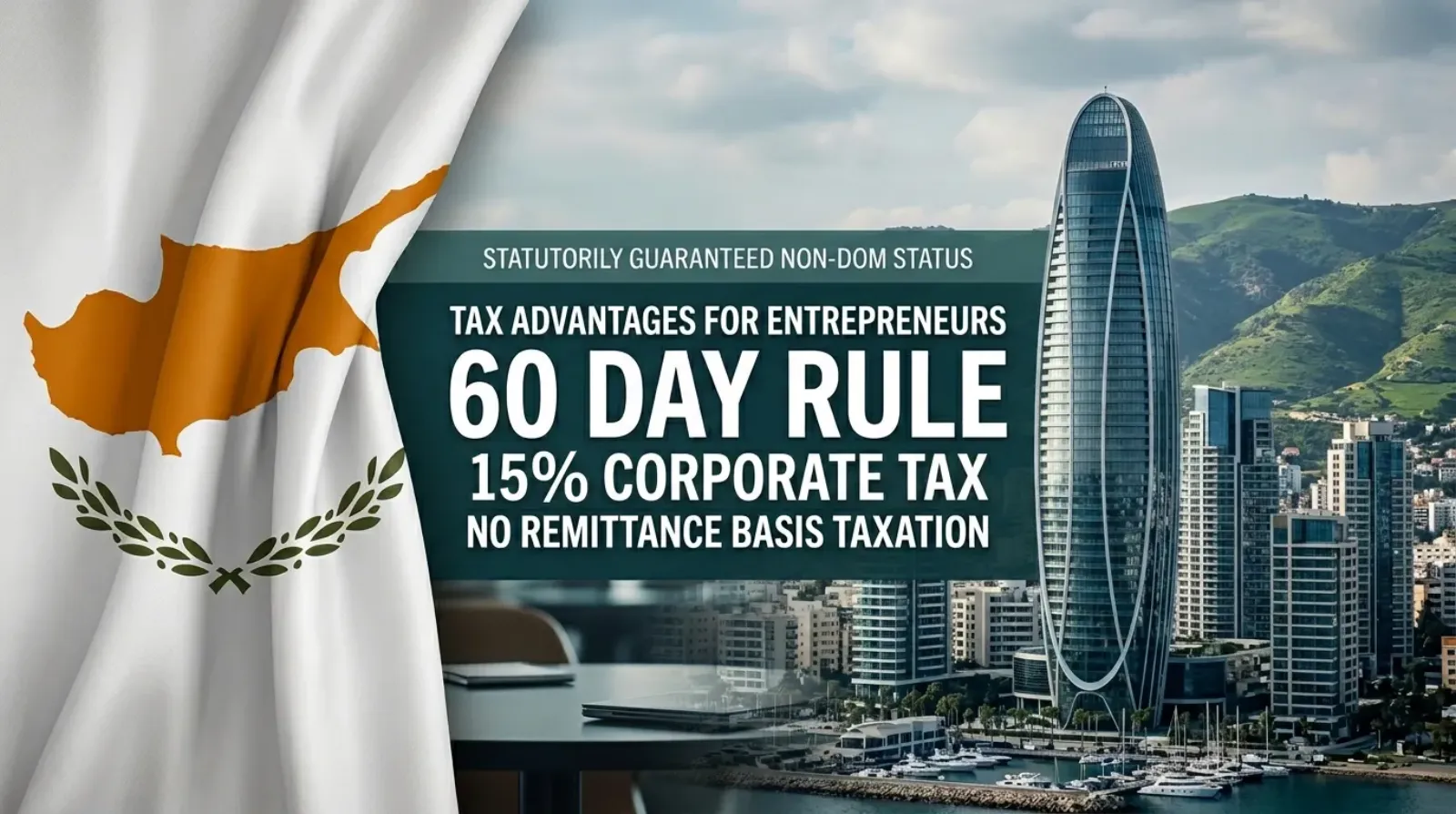
There is no 183-day rule and no remittance basis tax. This is one of the main reasons why thousands of entrepreneurs from across Europe keep moving to Cyprus. Cyprus also lets its Non-Dom residents apply for a tax certificate that is recognised internationally.
60 days instead of 183 days
In the EU and beyond, the usual test for tax residence is the 183-day rule. If you move to Cyprus and use Non-Dom Status, the 60-day rule in the tax law of the Republic of Cyprus (EU) applies instead.
In plain terms: Cyprus usually accepts your tax residence and gives you the full benefits of Cyprus Non-Dom Status if you stay 60-plus days a year.
No remittance basis taxation
Cyprus tax law adds another helpful feature to Cyprus Non-Dom Status: it drops remittance basis tax completely.
So, as a Non-Dom in Cyprus, you can receive dividends from Cyprus and from abroad tax-free. You can also move, hold or use the money you build up freely, anywhere in the world. Malta, Ireland and the old UK system all use a remittance basis. We compare them on our no remittance basis page.
OECD CRS and EU-FATCA
Cyprus takes part fully in the OECD CRS and EU-FATCA automatic exchange of information – and that works in your favour. Under these rules, banks report account data to the country where the account holder, or the real owner, is tax resident. Once Cyprus is your tax residence and the centre of your life, everything runs through a single, compliant channel: Cyprus. And because Cyprus does not tax interest or investment income, and dividends from Cyprus and from international companies are tax-free for Non-Dom residents, there is nothing left to reconcile or report somewhere else. Here, transparency is the feature: one residence, one clear set of rules, fully compliant.
Cyprus is not, by definition, a low-tax country
By international rules, Cyprus is not a low-tax country. In international tax law, a low-tax country is one whose personal income tax rate is much lower than the rate in the country you came from. The standard personal income tax rate in Cyprus goes up to 35 percent. Rules such as the half-income tax rate, given to foreign nationals under Non-Dom Status, are legal exceptions. They do not make Cyprus a low-tax country.
15 percent corporate income tax
This is about Cyprus tax for Cyprus Limited and Cyprus Holding companies. Corporate income tax in Cyprus is 15 percent, and there is no trade tax. So the 15 percent rate applies directly, and only, to company profit.
What Is the Non-Dom Status in Cyprus?
Cyprus Non-Dom Status allows individuals who are not of Cypriot origin (non-domiciled) to claim extensive tax exemptions once they move their tax residence to Cyprus. For 17 years, worldwide dividends and interest remain entirely tax-free, regardless of whether that income is transferred to Cyprus.

Current Cyprus Personal Income Tax Rates
The Cyprus personal income tax rate runs from 0 percent to 35 percent. Income is tax-free up to EUR 22,000, and the 35 percent rate starts from EUR 72,001. Cyprus personal income tax is progressive: the higher your private income, the higher the rate.
| Annual income | Tax rate |
| EUR 0 – EUR 22,000 | 0% |
| EUR 22,001 – EUR 32,000 | 20% |
| EUR 32,001 – EUR 42,000 | 25% |
| EUR 42,001 – EUR 72,000 | 30% |
| From EUR 72,001 | 35% |
Worked Example
If an employee in Cyprus earned EUR 40,000 in 2026, the personal income tax is worked out like this:
| Income (EUR) | Tax rate | Tax liability (EUR) |
| 0 – 22,000 | 0% | 0 |
| 22,001 – 32,000 | 20% | 2,000 |
| 32,001 – 40,000 | 25% | 2,000 |
| Total personal income tax | 4,000 |
Requirements for Cyprus Non-Dom Status
To get Cyprus Non-Dom Status, you must be tax resident in Cyprus and not domiciled there. In other words, the centre of your tax life must be in Cyprus, and you must not have Cypriot origin or earlier residence under Cypriot domicile law.
You are usually counted as tax resident if you spend at least 60 days a year in Cyprus, have a home there, and either run an activity or hold shares in a Cyprus company. At the same time, you must not have another country of residence where you stay more than 183 days.


Applying for Cyprus Non-Dom Status
You apply for Cyprus Non-Dom Status after you register for tax. Among other things, you usually need a valid residence permit (for example the Yellow Slip), proof of address, and proof of a link to Cyprus, such as company shares, an activity or a property arrangement.
Registration is usually done at the same time as you get your Tax Identification Number (TIC). On request, our team handles the full preparation and deals with the authorities for you.
Three Routes to Cyprus Residence with Non-Dom Status
EU citizens have three main routes to Cyprus residence with Non-Dom Status. The table below shows the requirements for each one side by side.
| Details | Option A CY Company Formation — for international business and Cyprus Non-Dom Status |
Option B Cyprus Non-Dom Status — for sole traders / self-employed in Cyprus |
Option C FIP — Financially Independent Persons (Note 2)* |
| Services and Fees | Services and Fees | Services and Fees | Services and Fees |
| Company formation and Non-Dom registration from A to Z | Step by step to Non-Dom Status | ||
| Passport (proof of identity), valid for at least 6 months | required | required | required |
| Employment contract (signed and stamped by employer) | required | not applicable | not applicable |
| Proof of payment for relevant insurance contributions and employment contract | required | required | not required |
| Registration fee EUR 20 (cash payment only) | required | required | required |
| Proof of valid health insurance (outpatient and inpatient care) Options: 1) S1 / E121 form, 2) E106 form, 3) Cyprus health card, 4) Private health insurance. If the insurer is in another country, the insurance agreement must be submitted and must cover both outpatient and inpatient costs. |
not required | not required | Private insurance required (Option 4) |
| Rental contract or proof of ownership | required | required | required |
| Proof of income (certified bank statements for the past 6 months) | not required | not required | required |
| Minimum stay per year | 60+ days | 60+ days | 183+ days |
| Implementation | Straightforward | Moderate effort | Straightforward, provided the above requirements are met |
| Notes | |||
| Note 1 |
The applicant or freelancer has already carried out the business activities they wish to register in Cyprus. Evidence of prior business activity such as trade licences, documents showing existing client relationships, and similar must be submitted where required. Other prerequisites are a short CV and qualifications for the business activities to be carried out in Cyprus. The application also requires utility bills (water and electricity), made out to the applicant and addressed to their current Cyprus address. |
If the applicant owns a foreign or offshore company, they must provide proof of income. This can be evidenced by bank statements showing a personal monthly minimum income of EUR 2,500 to 3,000 over the past three to six months and a balance of EUR 15,000 to 20,000 in the applicant's bank account. |
|
Moving Your Residence to Cyprus
If you want to move your home to Cyprus, or you have already been in Cyprus for more than three months without a break, you should register with the immigration authority. The Yellow Slip confirms that you live in Cyprus.
Continue reading: tax residence in Cyprus and the 60-day rule.
We are happy to assist!
for a free consultation
with one of our experts
Readers were also interested in
Our Terms & Conditions and our Terms of Use.