







Corporate Tax in Malta
For years, Malta has sold itself on a very low effective corporate tax and low running costs. At first glance, this looks good for entrepreneurs who want a tax-efficient company inside the European Union. But a closer look tells a different story. The law, the structures you need, and the real total costs all point another way. This page explains how the Maltese system works in practice, where the problems are, and why Cyprus is usually the better choice for most international entrepreneurs.
Table of Contents
- Is the apparent advantage really worth it?
- The legal starting position in Malta 2026
- When the shareholder lives in Malta
- When the shareholder lives abroad
- The new 15% rule in Malta (FITWI)
- Structure and substance in Malta
- Banking and compliance in Malta
- Costs and administrative effort in Malta
- Legal uncertainty and the EU perspective
- Conclusion and practical assessment

Is the Apparent Advantage Really Worth It?
What matters is not the headline tax rate. What matters is how much is left after taxes, effort, and paperwork.
Our team has worked in Cyprus for more than twenty years. We advise entrepreneurs on how to set up, tax, and structure international companies. We have offices in several countries, and we pick each location for clear professional reasons. We stay only where the tax and legal rules give our clients lasting, real advantages. If Malta were truly the better choice on corporate tax, legal certainty, and costs, we would have opened an office there long ago. After careful study and years of watching the market, it is clear that Malta does not deliver in practice what many providers promise.
The Legal Starting Position in Malta 2026
In Malta, the standard corporate tax rate is still 35 percent. This tax comes from the Income Tax Act, Chapter 123, and in principle it applies to every company registered in Malta. But the real tax you pay depends on who owns the shares and where that owner is tax-resident.
When the Shareholder Lives in Malta
If the shareholder lives in Malta and is tax-resident there, the company pays 35 percent corporate tax on its profit. This tax is final. When the profit is then paid out as a dividend, the shareholder pays no extra tax. This is because of the imputation system. The tax the company already paid counts as if the shareholder had paid it. So there is no double taxation.
Example
A Maltese company makes a profit of EUR 100,000. It pays EUR 35,000 in corporate tax. The remaining EUR 65,000 is paid out as a dividend to the shareholder. The shareholder must declare the dividend in their tax return, but gets full credit for the tax already paid. So the tax is fully settled. They can keep, spend, or invest the EUR 65,000 in Malta freely, with no further charges.
The effective tax burden here is 35 percent. There is no refund and no tax relief in this case, but also no double taxation.


When the Shareholder Lives Abroad
If the shareholder lives outside Malta, the refund system applies in principle. This system lets you claim back part of the corporate tax after a dividend is paid out. It is not a tax exemption. It is a complex refund process that only works if you meet every formal requirement.
First, the company pays the full 35 percent corporate tax. After the dividend is paid out, the foreign shareholder can apply for a six-sevenths refund of the tax paid. This brings the effective tax in Malta down to around 5 percent. But the refund is only paid after the Maltese tax office reviews and approves it, and this often takes a long time, causing delays.
In practice, this low rate is usually only possible with a holding structure. The refund does not go to the operating company. It goes only to its shareholder. If the shareholder is an individual living abroad, they would have to register for tax in Malta, get a Maltese tax number, open a local bank account, and file the application in person. This means heavy checks, substance requirements, and paperwork, so individuals can almost never do this directly.
For this reason, in almost every case a second company is set up in Malta to act as a holding company. This holding company owns the shares in the operating company, receives the dividend, applies for the refund, and then passes the rest of the profit to the real owner. The result is a two-tier structure. It brings extra setup costs, double bookkeeping, separate annual accounts, local directors, and ongoing audits. Without this structure, the advertised rate of around 5 percent is impossible to reach in practice.
In practice, this system is mainly for foreign shareholders without tax residency in Malta. It applies to both individuals and companies, but the registration and proof requirements are different.
If the shareholder is an individual living in a high-tax EU country, they need to know one thing: the dividend paid out in Malta is taxable in their home country. Malta charges no withholding tax on dividends, so the full amount reaches the shareholder. The shareholder must then declare the dividend in their home country as income from capital.
Example (individual shareholder)
A Maltese company makes a profit of EUR 100,000 and pays EUR 35,000 in corporate tax. The after-tax amount is paid out as a dividend. The shareholder lives in a high-tax EU country. They apply for the refund and, after a successful review, get EUR 30,000 back. So their effective tax burden in Malta is about EUR 5,000. But this refund does not change the fact that they must still pay tax on the dividend in their home country. This is typically a flat capital gains tax in the range of 25% to 27.5%, plus any surcharges.
So in the end, the combined tax burden does not result in a combined tax burden of 5%. Depending on the country, it is significantly higher. In many EU countries, the dividend counts as foreign capital income and is taxed at a dividend withholding tax of around 25% to 27.5%. The Maltese tax already paid can sometimes be partly credited, but full relief is rare.
If the shareholder is a legal entity, for example a holding company in a high-tax EU jurisdiction, then the local corporate tax rules and the EU Parent-Subsidiary Directive also apply. In many cases, the tax paid in Malta can be partly credited, but double taxation cannot always be fully avoided. On top of this, tax offices in many high-tax EU countries regularly ask for evidence of economic substance in Malta before they grant any tax benefit.
Example (corporate shareholder)
A holding company in a high-tax EU country owns 100 percent of the shares in a Maltese subsidiary. The subsidiary makes a profit of EUR 500,000 and pays EUR 175,000 in corporate tax. After the dividend is paid out, the holding company applies for the refund and gets EUR 150,000 back. So the net tax burden in Malta is EUR 25,000, or 5 percent. In the holding company's home country, the dividend counts as participation income. If the holding qualifies under the EU Parent-Subsidiary Directive, it may be tax-free. If it does not qualify, it is typically taxed at local corporate tax of around 25 percent.
These examples show that the often-quoted "5% tax rate" does not reflect the full tax reality. The Maltese tax only covers the company level. At the shareholder level, further tax may arise in the country of residence.
To summarise: the real total tax burden depends on where the shareholder lives, what type of income it is, and whether an individual or a company holds the shares. Once you count the dividends taxed back home, the advertised Malta advantage often shrinks a lot.

The New 15% Rule in Malta (FITWI)
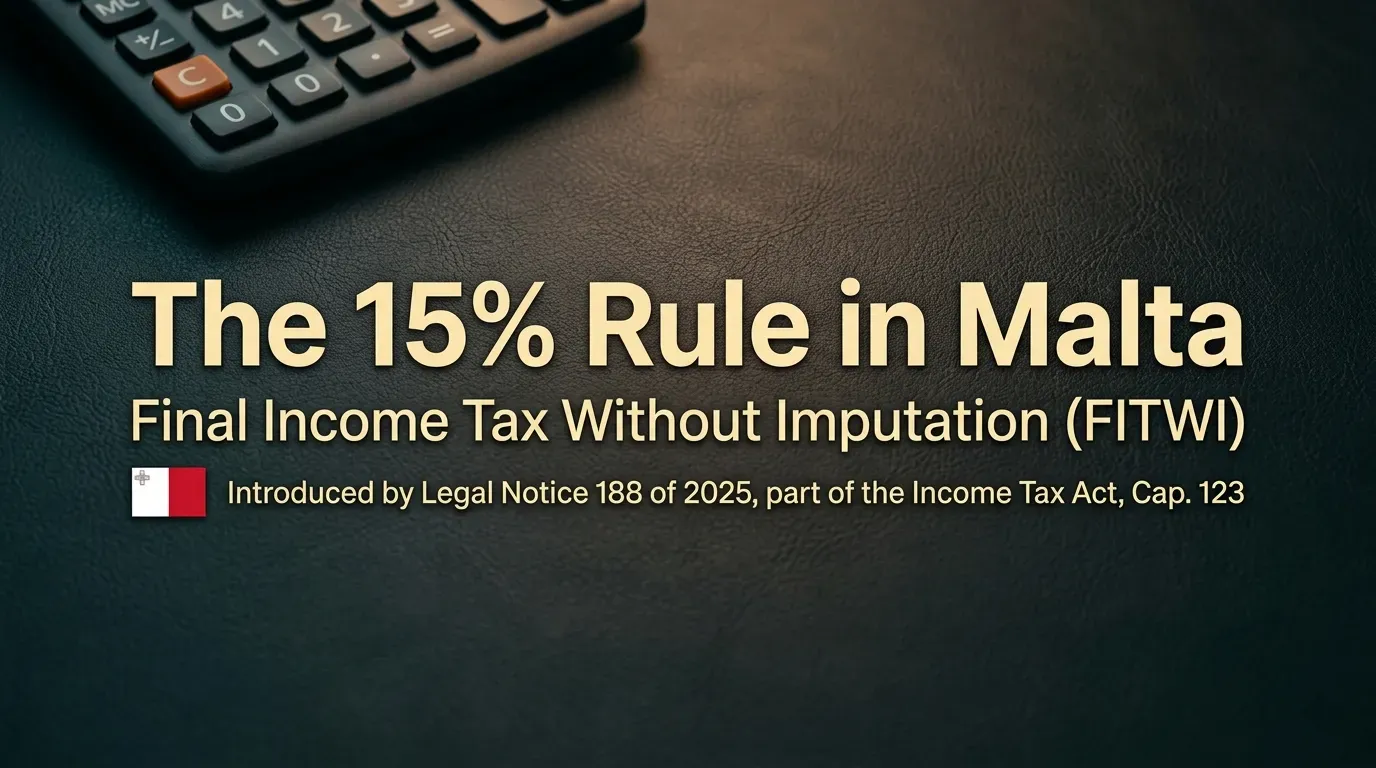
Since 2025, Maltese companies can choose a new way to be taxed instead of the old refund system: the Final Income Tax Without Imputation, or FITWI for short. It was brought in by Legal Notice 188 of 2025 and is part of the Income Tax Act, Cap. 123. The goal is to simplify the complex refund procedures and to be increasing transparency towards the European Union.
Under the FITWI rule, the profit of a Maltese company is taxed at 15% corporate tax. This tax is final. That means there is no credit at shareholder level and no refund. So the company pays a fixed tax on its profits and pays out the rest.
In other words, once a company chooses FITWI, the old refund system and the six-sevenths refund disappear entirely. The tax is final. This makes things much simpler, but it also removes any way to bring the effective tax rate below 15 percent.
Example
A company makes a profit of EUR 200,000. It has chosen FITWI and pays EUR 30,000 in corporate tax. The remaining EUR 170,000 can be paid out as a dividend. Neither the company nor the shareholder can apply for a refund or claim any further credit. So the tax in Malta is final.
Structure and Substance in Malta
In theory, the Maltese tax system with its refund process is fairly easy to describe. In practice, economic substance decides whether a company is really accepted and gets the tax benefits. Today the Maltese tax authorities check very carefully whether a company truly exists in Malta or only on paper. This check follows the Income Tax Act and the EU Anti-Tax-Avoidance Directives (ATAD) strictly.
To get a refund approved, a company must show it has real effective management and control in Malta. That means the company's administrative decisions must be taken on Maltese soil, not by a director living in another country. A pure letterbox company does not meet these requirements.
In practice, the following are required:
- A dedicated business address with an office that can actually be used.
- At least one local director who lives in Malta and legally represents the company.
- Demonstrable business activity, such as contracts, invoices, correspondence, and bank transactions.
- Ongoing bookkeeping and audited annual financial statements in Malta.
If these things are missing, the refund is usually not approved or later taken back. In some cases it can even be withdrawn after the fact, and the company is re-assessment at the full 35%.
Whether tax is levied at the company level or the shareholder level, complete tax exemption does not exist. The company first pays 35 percent corporate tax. If a refund is granted under the refund system, the tax in Malta drops in theory to around 5%. But in the shareholder's home country, the dividend is usually taxed again.
For example, a shareholder living in a high-tax EU country also pays a flat capital gains tax of around 25% to 27.5%, plus possible surcharges. In practice, this often leads to a combined burden of more than 30%, whether the dividend goes to an individual or to a company.
Example: the practical effort involved
An international entrepreneur sets up an operating company in Malta and applies for a tax refund after the first financial year. But the company has no director of its own in Malta, no business premises, and no staff. The tax office decides the company does not have enough economic presence. The refund is refused, and the EUR 35,000 already paid in tax stays with the state in full.
To avoid this risk, many clients hire service providers to build substance for them, through rented office space, Maltese directors, and local administrative services. But this creates large additional fixed costs, which in practice often run to several tens of thousands of euros per year.
So the reality is far from the simple idea that you set up a company in Malta, pay 5 percent tax, and keep the rest. Building and keeping the required substance is complex, expensive, and slow. In practice, it only makes economic sense for the few companies that really run an operating business in Malta and take decisions there regularly.


Banking and Compliance in Malta
One of the biggest practical problems in Malta is banking. On paper, payments for Maltese companies look simple. In reality, opening and operation of a business account is often the hardest part.
For several years now, Maltese banks have had to follow very strict EU rules on anti-money laundering (AML) and on counter-terrorist financing (CFT). These rules became tighter after Malta was put for a time on the "Grey List" by the Financial Action Task Force (FATF). The country was removed again in 2022, but banking practice has changed for good.
Opening an account today is laborious, time-consuming, and not guaranteed. Banks ask for a lot of proof: where the money comes from, who the real owners are, and what the business actually does. Without local substance, such as office space, local management, or real activity, most banks reject the application. Even if you hand in every document, opening an account often takes several months, with many follow-up questions.
Without a bank account, however, there can be no business activity and no refund. The refund can only be paid into a Maltese bank account in the name of the company or the holding company entitled to it. Anyone without an active bank account in Malta cannot get the refund in practice.
A practical example
An entrepreneur sets up a company in Malta and hands in all the documents to open an account. Everything is complete, but the bank asks for more proof: where the starting capital came from, the director's qualifications, and the business activity within the EU. The process drags on for four months. When the company finally wants to apply for a refund, the tax office refuses to pay it out, because there is no active Maltese business account. The result: the company is formally entitled to the refund, but cannot receive it.
Beyond banking, compliance practice in Malta has also become much stricter. The authorities check not only when you set up, but all the time, whether a company is meeting its duties. These include:
- Filing tax returns and annual accounts on time.
- Filing the beneficial owners with the Register of Beneficial Owners.
- Following the rules on economic substance and management.
Mistakes or gaps quickly lead to penalties, delays in refunds, or even removal from the commercial register. Many international entrepreneurs also report that even small changes, such as appointing a new director or changing the registered office, are treated by banks and authorities as a full re-check. As a result, all documents must be filed again and the whole compliance review repeated.
The combination of strict banking supervision and extensive evidence obligations makes Malta unworkable for many international entrepreneurs. Even those who meet the formal rules of the refund system often struggle with day-to-day work. There are few banks, the reviews are complex, and the time to actual payout is long.
In practice, even properly set-up companies wait several months or longer for an account to be opened or for the refund to be paid out. These delays add costs, tie up cash, and shrink the already small tax advantage that the refund system could in theory give.
Costs and Administrative Effort in Malta
If you look at the real cost of running a company in Malta, you quickly see that the work and the cost are much higher than people think. The low tax rate advertised with the refund system hides a complex and expensive web of legal, accounting, and organisational duties.
Setting up a company in Malta already needs a lot of formal steps. Once the company exists, it must keep regular accounts straight away, have an annual audit, and file audited accounts with the authorities. These duties apply whether the company trades actively or has no turnover at all.
When you add a holding structure, many of these duties double. Each company, both the operating one and the holding one, needs its own bookkeeping, annual accounts, audit reports, and tax returns. On top of that, each company needs a local director who acts as legal representative and carries the responsibility.
Besides the legal duties, ongoing costs in practice come from:
- Local administrative work, such as keeping the register of beneficial owners.
- Tax support and annual returns.
- Audits and director meetings, which must be held at least twice a year.
- Administration of refund applications and the related letters to the tax office.
- Substance reviews, which must be proven on an ongoing basis.
- Bank compliance reviews and changes to new rules.
So in practice, the total cost of running a Maltese structure is often clearly out of line with the possible tax saving. This is especially true for small and medium businesses that have no staff or office of their own in Malta.
Even where refund structures are functioning, the financial advantage often turns out to be smaller than expected, because much of the possible saving is eaten up by ongoing admin costs, bookkeeping, audits, and bank fees.
A typical case from advisory practice
An international entrepreneur sets up an operating company in Malta plus a holding company to claim the refund. Both companies must be managed, audited, and looked after for tax. On top of this come the yearly director meetings, the substance paperwork, and the constant letters to banks and authorities. After all running costs, audit fees, and admin costs are taken out, the real tax advantage shrinks to a fraction of the value first advertised.
On top of that, the demands for paperwork, compliance, and governance grow every year. Even well-established companies must regularly show their business records, ownership structure, and cash flows to authorities and banks. Any slip can lead to delays, more questions, or, in the worst case, a refused refund.
The idea that one can build a simple and inexpensive structure in Malta does not match the reality. The admin work is heavy, the controls are wide, and the cost in money and time is often out of line with the tax result.
In the end, there is no way around the conclusion: the advertised tax rate of 5% is never the actual overall burden in practice. Whether the shareholder is a company or an individual, and whether they live in Malta or abroad, once you count the local or home-country tax and the heavy ongoing costs, the effective burden is regularly well above that figure.
In practice, Malta mainly suits larger company groups that have real substance and their own admin team. For sole entrepreneurs or smaller international companies, the benefit is usually limited, because the follow-on costs are so high.
Legal Uncertainty and the EU Perspective
For years, Malta has presented its corporate tax system as competitive and EU-compliant. But the refund system has long been watched closely by the European Commission, the OECD, and the EU Code of Conduct Group. The reason: by refunding most of the corporate tax, Malta stays formally inside the EU legal framework, but the structure can in practice be seen as a "state aid-like tax benefit".
The European Union judges national tax systems on one basis: they must not constitute harmful tax practices. A system is seen as harmful if it gives international investors selective advantages that local taxpayers cannot get. That is exactly the case with the refund system: only non-resident shareholders can claim the refund.
So Malta has therefore been under observation by the EU Code of Conduct Group for years. The system has not been officially banned yet, but it is politically controversial and comes up again and again on the agenda of European tax working groups.
With the Final Income Tax Without Imputation (FITWI) in 2025, Malta reacted directly to this pressure. FITWI is meant to replace the current refund system over time and to remove the charge that non-resident shareholders get special tax treatment.
This development clearly shows that the existing system, in its current form, is hardly viable in the long run. Companies that rely on refund structures today must expect the rules to change further in the coming years. A formal end to the refund system has not been decided yet, but it is seen as a likely scenario if Malta does not bring in more reforms.
The OECD, through its BEPS (Base Erosion and Profit Shifting) project, also looks regularly at national tax models based on refunds. The goal is for profits to be taxed where the actual value creation is. The Maltese system, which allows refunds without operating activity in the country, goes against this international goal.
The European Commission has also said many times that EU corporate tax law should be brought closer together over time, in particular through initiatives like BEFIT (Business in Europe: Framework for Income Taxation), with the long-term aim of one shared tax base. As a result, special national models like the Maltese refund system may lose their long-term tax-policy viability.
There is one more source of uncertainty: how the rules are applied in practice. The Maltese tax office has wide margin of discretion when it reviews refund applications. Whether an application is approved or refused depends not only on the formal rules, but also on the office's view of whether there is enough substance and a real business purpose. In practice, this often leads to unpredictable decisions and long review procedures.
An example from practice
A holding company based in Malta, whose owner lives in a high-tax EU country, applies again for a refund after several successful years. The company meets all the formal rules, but has no staff of its own and only one local director. This time, the tax office questions the refund and asks for more proof of operating activity in Malta. The matter drags on for more than a year. The outcome stays open, and during that time the company cannot use the money in question.
These uncertainties have led to a loss of confidence in recent years. Many banks and tax advisers now warn against refund structures, because the risk that applications are refused or delayed for years has grown a lot. And a refund that is taken back later can have serious financial effects: if the refund is later found to be wrong, it must be paid back in full, often with interest and possible penalties.
Overall, Malta is not unstable in legal terms, but it is unpredictable in its practical application. When planning any structure, entrepreneurs should allow for the chance that the current rules stay in place formally but change because of European or international developments.
The refund system is not a durably reliable model. It is a temporary tax-policy arrangement that keeps losing importance. For long-term business planning, it therefore carries higher legal and political risk.


Conclusion and Practical Assessment
At first glance, the Maltese corporate tax system looks attractive. A headline rate of 35 percent, cut by a refund to around 5 percent, sounds like a clear advantage. But on a realistic view, this impression does not hold up.
The legal and practical implementation is complex, expensive, and tied to many conditions. To get the refund at all, you almost always need a two-tier structure: an operating company and a Maltese holding company. Both must be managed, audited, and looked after for tax. On top of this come high substance requirements, extensive compliance obligations, time-consuming banking processes, and a legally uncertain future for the refund system.
Even when all conditions are met, the total tax bill in practice never comes down to an actual burden of 5%. Once you count the cost of keeping the structure, the ongoing audits, the admin fees, and the tax in the shareholder's home country, the effective burden is regularly well above 30%, often higher than in comparable EU countries with clearer rules.
There is also legal uncertainty. The refund system has been under EU watch for years and will probably be replaced step by step by the new FITWI system, which sets a fixed tax of 15%. This shows that Malta is not unattractive for tax, but it is structurally unstable. And for long-term business plans, stability is what counts.
By comparison, Cyprus offers a much clearer, more transparent, and more predictable environment. The corporate tax rate is 15 percent, taxation is uniform and without refund procedures, and the rules are easy to follow. You generally do not need holding structures to gain tax advantages, and there are no waiting times for refunds.
Cyprus also offers a clear Non-Dom regime, which is especially valuable for internationally active entrepreneurs. Income from dividends and interest can be fully tax-free under certain conditions, and the banking system is stable, fast, and pragmatic for international structures.
Administrative costs in Cyprus are usually lower, the processes are digitalised, and dealings with the authorities are prompt and transparent. Companies can generally rely on a clear legal basis that has been stable and EU-compliant for years.
Taken as a whole, the picture is clear: Malta is not an unlawful, but an impractical jurisdiction as a place to base a company. Cyprus, by contrast, offers a sustainable, legally secure, and economically sensible alternative, with clear rules, manageable effort, and far more planning certainty for entrepreneurs.
Anyone looking for a European corporate structure that is legally secure, simple, and tax-predictable will often find in Cyprus the model that Malta long claimed to be: clear, efficient, and reliable in the long term.
We are happy to assist!
for a free consultation
with one of our experts
Readers were also interested in
Our Terms & Conditions and our Terms of Use.